Friday, 10 March 2023

Hello foreign parent company


Meaning of Foreign Subsidiary Company
foreign subsidiary company is any company, where 50% or more of its equity shares are owned by a company that is incorporated in another foreign nation. For example, a company incorporated in USA (Parent company) is executing the same business operation through an Indian subsidiary company. However, this company should abide by the rules and regulations of the domestic law of the corresponding country where it is situated, it should not follow the laws applicable to its parent company.

As per section 2, clause 22, “dividend” includes

1.    Distribution of accumulated profits to shareholders entailing release of the company’s assets; 

2.    Distribution of debentures or deposit certificates to shareholders out of the accumulated profits of the company and issue of bonus shares to preference shareholders out of accumulated profits;

3.    Distribution made to shareholders of the company on its liquidation out of accumulated profits; 

4.    Distribution to shareholders out of accumulated profits on the reduction of capital by the company; and 

5.    Loan or advance made by a closely held company to its shareholder out of accumulated profits.

Taxability of Dividends before AY 2020-2021:
If a shareholder gets dividend from a domestic company on or before the 31st day of March, 2020, then he/she shall be exempt from tax under section 10(34) of the Act and the domestic company is liable to pay a Dividend Distribution Tax (DDT) @15% (excluding surcharge and cess) under section 115-O of the Income Tax Act. In case of dividend under Section 2 (22) (e), the DDT rate shall be substituted from 15% to 30%.

Taxability of Dividends paid by Indian company to Foreign Parent Company

Tax Withheld u/s 195 on the Dividend paid to Foreign Parent Company: In accordance with the provisions of Section 195 of the Income Tax Act, tax is required to be withheld @ 20% (plus applicable surcharge and cess) on the amount of dividend payable to foreign parent company. The TDS withheld by the payer must be deposited to the Government within 7
th of the next month (except in case of Tax Deductible in March, the due date is 30th April of the next year.  

Section 90- Avoidance of Double Taxation Avoidance Agreement
As per section 90 of the Income Tax Act, a non-resident shareholder has an option to be governed by the provisions of the Double Taxation Avoidance Agreement (‘DTAA’) between India and the country of tax residence of the shareholder, if such provisions are more beneficial to such shareholder to avoid of double taxation of income under this Act and under the corresponding law in force in that country. Here are the few examples:

1.    Tax treaty between India and Germany determines that their bilateral withholding tax on dividends is 10%, then India will tax dividend payment that are going to Germany at a rate of 10%, and vice versa.

2.    In case of tax treaty between India and Canada, the withholding tax on dividend is 15% if at least 10% of the shares of the company paying the dividends is held by the recipient of dividend. But in other cases, the withholding tax on dividend is 25%, hence the India will tax divided payment at the rate of 20%.

3.    In case of tax treaty between India and United Kingdom, the withholding tax on dividend is 10%. But in case the dividends are paid out of income (including gains) derived directly or indirectly from immovable property within the meaning of Article 6 by an investment vehicle, the withholding tax on dividend is 15% of the gross amount of the dividends.

Documents required by the non-resident shareholder to avail the DTAA benefits:

·        Self-attested copy of PAN, if any, allotted by the Indian tax authorities.  In case of non-availability of PAN, declaration is to be submitted.

·        Self-attested copy of valid Tax Residency Certificate (‘TRC’) issued by the tax authorities of the country of which shareholder is tax resident, evidencing and certifying shareholder’s tax residency status.

·        Completed and duly signed self-declaration in Form 10F.

·        Self-declaration certifying the following points that the shareholder: –

1.    is and will continue to remain a tax resident of the country of its residence during the FY

2.    is the beneficial owner of the shares and is entitled to the dividend receivable from the Company.|

3.    qualifies as ‘person’ as per DTAA and is eligible to claim benefits as per DTAA for the purposes of tax withholding on dividend declared by the Company.

4.    has no permanent establishment / business connection / place of effective management in India OR Dividend income is not attributable/effectively connected to any Permanent Establishment (PE) or Fixed Base in India.

5.    has no reason to believe that its claim for the benefits of the DTAA is impaired in any manner

Relief under Section 91- Countries with which no agreement exists
When there is no agreement under section 90 for the relief or avoidance of double taxation, section 91
the Income Tax Act provides relief from double taxation in such cases. 

If any person who is resident in India in any previous year proves that, in respect of his income is not deemed to accrue or arise in India and with which there is no agreement under section 90, he shall be entitled to the deduction from the Indian income-tax payable by as under:

A sum calculated on such doubly taxed income at the Indian rate of tax or 
the rate of tax of the said country, whichever is the lower or 
At the Indian rate of tax if both the rates are equal.

Thursday, 14 May 2020

SABKA VISHWAS (LEGACY DISPUTE RESOLUTION) SCHEME, 2019 (open for 1-9-2019 to 31-12-2019)

  • With a specific window period to exercise the option
  • Proceedings under the scheme specifically stated to not be treated as a precedent for past and future liabilities
  • Coverage: — 28 enactments including Excise & Service Tax
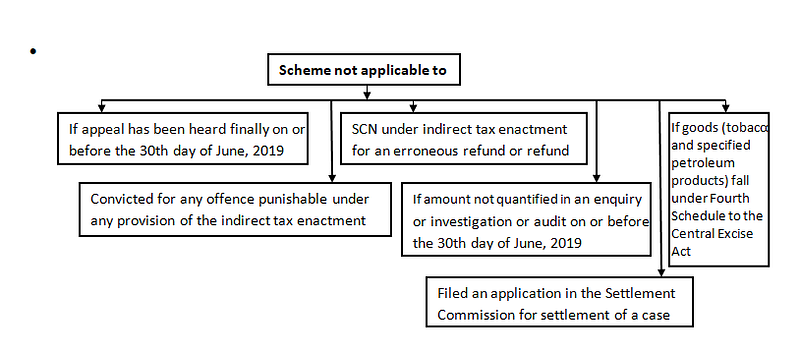
Note- the final hearing has not taken place as on 30.06.2019
*** ‘Quantified’ means a written communication of the amount of duty payable under the indirect tax enactment [Section 121(g)]. Such written communication will include a letter intimating duty demand; or duty liability admitted by the person during enquiry, investigation or audit; or audit report etc.
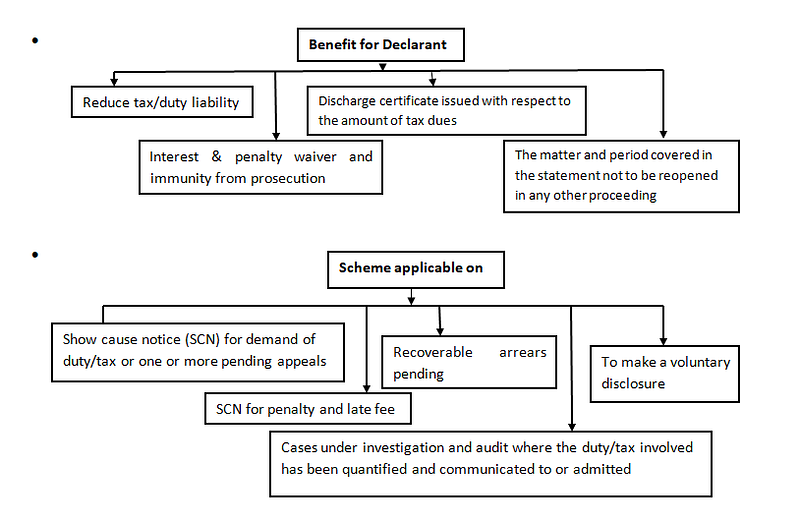
  • A person making a voluntary disclosure:-
     (i) After being subjected to any enquiry or investigation or audit; or
     (ii) Having filed a return under the indirect tax enactment, wherein he has indicated an amount of duty as payable, but has not paid it;
  • This scheme is applicable on –
     
    The Central Excise Act, 1944 or the Central Excise Tariff Act, 1985 or Chapter V of the Finance Act, 1994 and the rules made there under;The following Acts, namely:
     The Agricultural Produce Cess Act,1940, The Coffee Act, 1942, The Mica Mines Labour Welfare Fund Act, 1946, The Rubber Act, 1947, The Salt Cess Act, 1953, The Medicinal and Toilet Preparations (Excise Duties) Act, 1955, The Additional Duties of Excise (Goods of Special Importance) Act, 1957, The Mineral Products (Additional Duties of Excise and Customs) Act, 1958, The Sugar (Special Excise Duty) Act, 1959, The Textiles Committee Act, 1963, The Produce Cess Act, 1966, The Limestone and Dolomite Mines Labour Welfare Fund Act, 1972, The Coal Mines (Conservation and Development) Act, 1974, The Oil Industry (Development) Act, 1974, The Tobacco Cess Act, 1975, The Iron Ore Mines, Manganese Ore Mines and Chrome Ore Mines Labour Welfare Cess Act, 1976, The Sugar Cess Act, 1982 & The Finance Act.
  • This scheme provides for a substantial relief margin on all Duty demands, ranging from 40% to 70% of the demand, except in the case of voluntary disclosure. The relief will be applicable as follows-
Relief Available from the Duty Demand For Cases Pending Adjudication or Appeal* For Cases of Confirmed Duty Demands (Where No Appeal is Pending) For Cases of Voluntary Disclosure Duty demands up to Rs.50 lakh 70% 60% The full amount of duty disclosed Duty demands >Rs.50 lakh 50% 40%
  • The following consequences:
  • In case adjudication order determining the duty/tax liability is passed and received prior to 30.06.2019, but the appeal is filed on or after 01.07.2019 than not eligible under the Litigation category. However, such a person may choose to withdraw the appeal, and furnish to the department an undertaking to not file any further appeal in the matter. In this case, he can make a declaration under the Arrears category.
  • If any person convicted for an offence punishable under a provision of the indirect tax enactment. However, in respect of the same matter, I intend to file a declaration under the Scheme than such person will not be eligible.
  • Restrictions of Scheme.
     
    (i) Any amount paid under this Scheme:-
  • shall not be paid through the input tax credit account under the indirect tax enactment or any other Act;
  • shall not be refundable under any circumstances
  • shall not, under the indirect tax enactment or under any other Act:-
  • be taken as input tax credit; or
     (ii) Entitle any person to take input tax credit, as a recipient, of the excisable goods or taxable services, with respect to the matter and time period covered in the declaration.
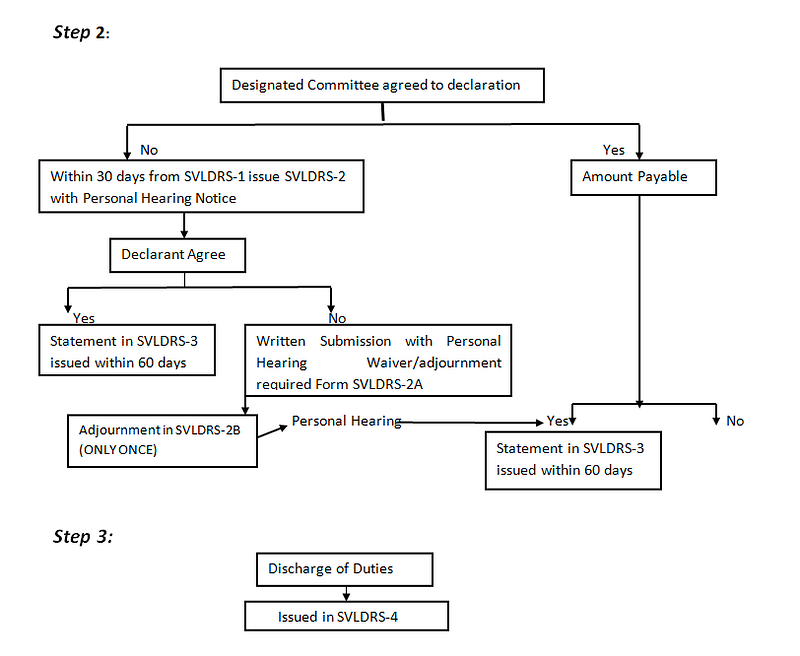
(ii) In case any pre deposit or other deposit already paid exceeds the amount payable as indicated in the statement of the designated committee, the difference shall not be refunded.
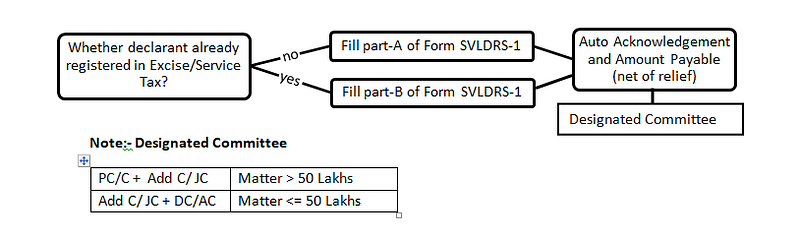
  • How to Apply for SVLDRS, 2019…
  • The taxpayer can apply for this scheme from https://cbic-gst.gov.in
  • The taxpayer already registered under CE / ST can login and fill Part-B of SVLDRS Form-1.
  • The unregistered taxpayer can register himself by filling Part-A of SVLDRS Form -1.
Declaration
Step 1:-

Tuesday, 17 March 2020

Taxation audit services in India

Taxation audit services in India

Service Tax has become an important compliance, specially with the amendment in regulation since 2012. Now almost every service is covered leaving a few exempted. This now has repercussions like registration, filing returns, calculation of service tax payable and so on. We provide Online Service Tax Registration services include end to end solution like advice on applicability of Service Tax to meeting compliances including Registration and filing of requisite forms with the Department. We also undertake review of specific agreements to identify the applicability of tax.
Ruchi Anand & Associates help you in the following areas:
  • Assessing applicability of service tax
  • Registration, single premises and centralized
  • Identifying impacts of latest updates on the entity/service
  • Assisting in calculation
  • Advising on availability of cenvat credit and utilization of the same as per the legislation.
  • Helping in assessments/ other departmental representation
  • Compliance and regulatory consultancy
  • Due Diligence
  • Payment and filing of service tax returns
  • Litigation matters
  • Preparation of appeals and appearing before the authorities.
  • Advising on documentation to be maintained.
  • Assisting in applying for refund of service tax, especially in export cases.
  • Service tax audit related assistance.
  • Structuring of business transactions to maximize tax efficiency
Audits are all about Checks, Controls and assurance, which may be complied statutorily or even be held voluntarily by the entity to assure the true view of business in terms of finance. You can rely on us for end to end audits and assurance services. Be it related to about Financial Statements, business processes or Information Technology.
Below are few of the Core Audit services, we master at:
  • Financial Statement Audits
  • IT controls
  • Projects
  • Compliance Audit e.g. Service Tax Audit, TDS Audit etc.
  • Audit of Infrastructural controls and security
  • Due Diligence
  • Management Audit
  • Efficiency Audit
  • Organization structure Audit- Hierarchy Audit
  • Corporate governance Audit
  • Internal Audits
Besides these core audit services, we undertake specially customized assignments:
  • Testing documentation and internal controls that belong to financial reporting
  • Data quality and controls - Assessments
  • Assisting in designing, implementation and testing of controls
  • Advance control structure and implementation
  • Preparation of process cycles/ process flows and related documentation
  • Business process controls - advisory
  • Gap Identification & Analysis
  • ERP controls – Assessment, Evaluations and implementation reviews

Monday, 2 March 2020

Internal audit firms in Delhi

Internal Audit is very important aspect, when we talk of assurance of true picture of state of affairs of an entity. It is checking within the entity. It helps in understanding and assessing risks and evaluates the internal controls and checks. It helps in ensuring optimum utilization of the resources of the entity, as well as timely identification of liabilities including the ones in contingent nature. Internal Audit helps ensuring adequacy of information systems security and controls. Statutorily also certain companies have to have Internal Audit in place.
What we offer you:
  • Assessing/ preparing Internal Audit Manual for the organization and Study of control objectives.
  • Advising organizational procedures being followed.
  • Analyzing Accounting and Audit manual.
  • Practicality and viability of existing controls and areas of improvement.
  • Assessment of risks and open points.
  • Checking the controls instituted within the system.
  • Determining controls that are adequate to meet control objectives.
  • Working out possible areas of improvement.
  • Comparison of written control policies and adherence to same.
  • Measuring deviation at test check levels.
  • Deciding on degree of control which is adequate depending upon organization to organization.
  • Consideration of Fraud in internal audit.
  • Internal audit sourcing and outsourcing.
  • Assets at risk and their protection.
  • Audit of Corporate Governance.
  • Evaluation of department for internal controls, if exist
  • Legal and situational internal control advisory.
  • Process Audits

Formation of Indian subsidiary

There can be two types of it based upon ownership namely
  1. 100% ownership
    • Fully owned subsidiaries (only in FDI permitted sectors as Per latest FDI policy)
  2. Less than 100% ownership
    • Joint Ventures
Indian subsidiaries enjoy same rights as basically Indian Companies. There are certain norms to the activities of proposed companies as per FDI policy of the Government. Many activities are permitted to bring 100% foreign investments whereas on some activities Government has put restrictions where Government gives permission of 100% FDI and in a few activities 100% FDI is not permitted and even Government route can not be availed. In those cases, Joint Ventures are good channel of investment, where a certain percentage is held by Indian entities. In the Joint Venture Form of working, foreign company can get a good financial resource with some ready contacts and experienced partners, however a complete privacy has to be a bit parted with.
Assistance in getting FIPB Approvals
There are two entry routes of direct investment in India (FDI):
  • Automatic Route
  • Government Route (Approval Route)
Depending upon the sector where proposed investment is to be brought in, the above segregation is done. In many a sectors, Government restricts 100% FDI like defense, telecom etc. For such sectors, one has to get the approval of Foreign Investment Promotion Board (FIPB)- a division of Finance Ministry. We assist you in getting the FIPB approvals, taking care of all the formalities so you can rest assured of our services.
Channels other than FDI:
A foreign company can also come and do business in India without investing directly. RBI has permitted such companies to have establishments in India for some limited purposes. Such forms are:
  • Liaison office
  • Project Office
  • Branch Office
Different permissions and freedoms are attached with each such office. So one has to be careful while making choice of these forms of work. RBI permissions have to be sought for each such organization subject to renewals as specified from time to time. Also, the foreign companies have to register with Registrar of Companies (ROC) within 30 days of setting up a place of business in India, besides the said RBI Approval.

Friday, 17 January 2020

Individual taxation solutions, Tax consultant in India

Foreign nationals come for job opportunities to India but are many a times not aware of Indian Taxation system. Even the Visa compliance is linked with tax certificates. We understand the difficulties that may strike their way. Many Non Resident Indians have investments in Indian properties and other business interests in India. Divestments and other activities involve taxation processes also. We provide non residents including NRIs best of the best solutions to advice on the taxes applicable on them and to plan those taxes effectively.
Areas that we cover in this are:
  • Applying and getting Indian PAN
  • Advice in FEMA matters
  • Preparation and advice on best project location
  • Project Finance Liaison
  • Sorting/ notifying changes in directors etc.
  • Government approvals in case of FDI
  • Repatriation of income
  • Filing Income Tax returns
  • Advice on DTAA (Double Taxation Avoidance Agreements) Benefits
  • Assisting in VISA
  • Getting RBI approvals for purchase and sale of properties, securities etc.
Globalization has created the requirement of studying the tax treaties and utilization of the maximum benefits from those. To avoid a situation of double taxation in cross border transactions, we help the clients to gain from our knowledge and thereby increasing/expanding the business.
Following are the areas of our specialization in the field:
  • Consultancy on Withholding of Taxes
  • Supporting to understand DTAAs
  • Expatriate Taxation
  • Analysis of deductions, exemptions etc. available
  • Full support on Withholding of Taxes
  • Advising on DTAAs between India and other countries
  • Liaison on Financing options for foreign entities
  • Helping in location tax benefits for holding/subsidiary companies set up.
  • Providing support in Departmental Litigation
  • Assisting on Departmental Representation
  • Watching supply chain that optimize in a manner to be tax efficient
  • Preparing and filing tax return, applying provisions of DTAA
Ruchi Anand & Associates help you in the following areas:
  • Checking applicability of transfer pricing regulations
  • Assessing the requirement of documents
  • Analysis of transfer of goods or services
  • Pricing strategy analysis
  • Calculation of profits
  • Finding best applicable method
  • Collecting Statistical facts
  • Preparation of Transfer Pricing Study.
  • Litigation support
  • Planning and advising best transfer pricing strategy in order to have minimal risk
At Ruchi Anand & Associates, we are all about service. We strive to develop long-term relationships with our clients, approaching each engagement with a focus on bringing value. Our senior professionals are actively involved in each engagement from inception to conclusion with smart sensitive approaches. We are one of top Indian Chartered Accountant Auditing Firms based in India at New Delhi. We provide Audit and Assurance Services, Risk Advisory and Tax Services for improving your financial efficiency, accuracy & stability. For more information visit our website:- http://www.raaas.com.

Tuesday, 14 January 2020

Electronic Mode for Accepting Payment (Section 269SU read with Rule 119AA)

Overview:
  • In furtherance to the declared policy objective of the Government to encourage digital economy and move towards a less-cash economy,Section 269SU shall come into force with effect from 1st November, 2019. The Central Government proposes to promote electronic modes of payment for the payer for the purposes of Section 269SU.
  • No Bank / System provider shall impose any charges on payer / Receiver making or receiving payments through electronic modes prescribed U/s 269SU of the Act. Even Merchant discount rate (MDR) shall not be applicable on or after 01.01.2020.
  • Rule 119AA mode of payment under Sec 269SU has been inserted and effective from 1st day of January, 2020.
To whom Sec- 269 SU apply:
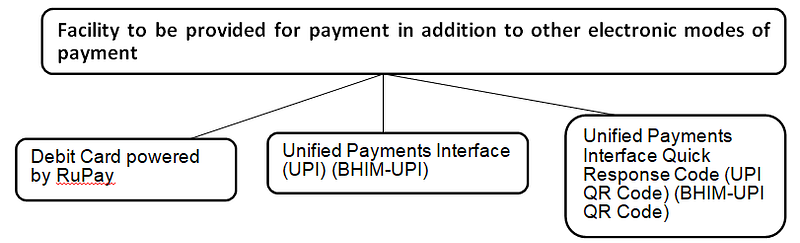
Every person carrying on business, If his total sales / Turnover or gross receipts in the business exceed 50 crores in the previous financial year (Specified Person) shall provide facility for accepting payment through prescribed electronic modes, in addition to the facility for other electronic modes, of payment, if any, being provided by such person.
Rule 119AA Modes of payment for the purpose of Section 269SU:
Every person
 with a business turnover of more than Rs. 50 crores has to mandatorily provide all the following modes for the purpose of acceptance of payment, which is in addition to the facility for other electronic modes of payment, if any.
Note: Notification 105/2019 and Circular 32/2019 dated 30.12.2019, it can be inferred that all the 3 alternatives as mentioned in (a), (b) & (c) need to be provided for accepting payment through electronic modes.
Section 10A of Payment and Settlement System Act 2007
A new provision namely Section 10A was also inserted in the Payment and Settlement Systems Act 2007, which provides that Bank or system provider shall not impose any charge on a payer making payment, or a beneficiary receiving payment, through electronic modes prescribed under Section 269SU of the Income-tax Act 1961.
Due Date for Compliance of Section 269SU:
Section 271DB of the Act shall not be levied if such person carrying on business installs and operationalises the facilities on or before 31st January, 2020.
Penalty for Violation of Section 269SU Provisions under Section 271DB:
Every person who fails to offer the prescribed modes (installation & operationalisation of the facilities) by 31st January 2020 would be subjected to a penalty of Rs. 5,000 per day of default with effect from 1st February, 2020.
Any penalty imposable under sub-section (1) shall be imposed by the Joint Commissioner of Income-tax.
At Ruchi Anand & Associates, we are all about service. We strive to develop long-term relationships with our clients, approaching each engagement with a focus on bringing value. Our senior professionals are actively involved in each engagement from inception to conclusion with smart sensitive approaches. We are one of top Indian Chartered Accountant Auditing Firms based in India at New Delhi. We provide Audit and Assurance Services, Risk Advisory and Tax Services for improving your financial efficiency, accuracy & stability. For more information visit our website:- http://www.raaas.com.