Friday, 17 January 2020

Individual taxation solutions, Tax consultant in India

Foreign nationals come for job opportunities to India but are many a times not aware of Indian Taxation system. Even the Visa compliance is linked with tax certificates. We understand the difficulties that may strike their way. Many Non Resident Indians have investments in Indian properties and other business interests in India. Divestments and other activities involve taxation processes also. We provide non residents including NRIs best of the best solutions to advice on the taxes applicable on them and to plan those taxes effectively.
Areas that we cover in this are:
  • Applying and getting Indian PAN
  • Advice in FEMA matters
  • Preparation and advice on best project location
  • Project Finance Liaison
  • Sorting/ notifying changes in directors etc.
  • Government approvals in case of FDI
  • Repatriation of income
  • Filing Income Tax returns
  • Advice on DTAA (Double Taxation Avoidance Agreements) Benefits
  • Assisting in VISA
  • Getting RBI approvals for purchase and sale of properties, securities etc.
Globalization has created the requirement of studying the tax treaties and utilization of the maximum benefits from those. To avoid a situation of double taxation in cross border transactions, we help the clients to gain from our knowledge and thereby increasing/expanding the business.
Following are the areas of our specialization in the field:
  • Consultancy on Withholding of Taxes
  • Supporting to understand DTAAs
  • Expatriate Taxation
  • Analysis of deductions, exemptions etc. available
  • Full support on Withholding of Taxes
  • Advising on DTAAs between India and other countries
  • Liaison on Financing options for foreign entities
  • Helping in location tax benefits for holding/subsidiary companies set up.
  • Providing support in Departmental Litigation
  • Assisting on Departmental Representation
  • Watching supply chain that optimize in a manner to be tax efficient
  • Preparing and filing tax return, applying provisions of DTAA
Ruchi Anand & Associates help you in the following areas:
  • Checking applicability of transfer pricing regulations
  • Assessing the requirement of documents
  • Analysis of transfer of goods or services
  • Pricing strategy analysis
  • Calculation of profits
  • Finding best applicable method
  • Collecting Statistical facts
  • Preparation of Transfer Pricing Study.
  • Litigation support
  • Planning and advising best transfer pricing strategy in order to have minimal risk
At Ruchi Anand & Associates, we are all about service. We strive to develop long-term relationships with our clients, approaching each engagement with a focus on bringing value. Our senior professionals are actively involved in each engagement from inception to conclusion with smart sensitive approaches. We are one of top Indian Chartered Accountant Auditing Firms based in India at New Delhi. We provide Audit and Assurance Services, Risk Advisory and Tax Services for improving your financial efficiency, accuracy & stability. For more information visit our website:- http://www.raaas.com.

Tuesday, 14 January 2020

Electronic Mode for Accepting Payment (Section 269SU read with Rule 119AA)

Overview:
  • In furtherance to the declared policy objective of the Government to encourage digital economy and move towards a less-cash economy,Section 269SU shall come into force with effect from 1st November, 2019. The Central Government proposes to promote electronic modes of payment for the payer for the purposes of Section 269SU.
  • No Bank / System provider shall impose any charges on payer / Receiver making or receiving payments through electronic modes prescribed U/s 269SU of the Act. Even Merchant discount rate (MDR) shall not be applicable on or after 01.01.2020.
  • Rule 119AA mode of payment under Sec 269SU has been inserted and effective from 1st day of January, 2020.
To whom Sec- 269 SU apply:
Every person carrying on business, If his total sales / Turnover or gross receipts in the business exceed 50 crores in the previous financial year (Specified Person) shall provide facility for accepting payment through prescribed electronic modes, in addition to the facility for other electronic modes, of payment, if any, being provided by such person.
Rule 119AA Modes of payment for the purpose of Section 269SU:
Every person
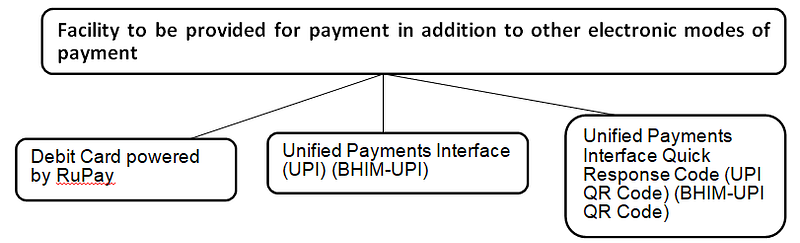
 with a business turnover of more than Rs. 50 crores has to mandatorily provide all the following modes for the purpose of acceptance of payment, which is in addition to the facility for other electronic modes of payment, if any.
Note: Notification 105/2019 and Circular 32/2019 dated 30.12.2019, it can be inferred that all the 3 alternatives as mentioned in (a), (b) & (c) need to be provided for accepting payment through electronic modes.
Section 10A of Payment and Settlement System Act 2007
A new provision namely Section 10A was also inserted in the Payment and Settlement Systems Act 2007, which provides that Bank or system provider shall not impose any charge on a payer making payment, or a beneficiary receiving payment, through electronic modes prescribed under Section 269SU of the Income-tax Act 1961.
Due Date for Compliance of Section 269SU:
Section 271DB of the Act shall not be levied if such person carrying on business installs and operationalises the facilities on or before 31st January, 2020.
Penalty for Violation of Section 269SU Provisions under Section 271DB:
Every person who fails to offer the prescribed modes (installation & operationalisation of the facilities) by 31st January 2020 would be subjected to a penalty of Rs. 5,000 per day of default with effect from 1st February, 2020.
Any penalty imposable under sub-section (1) shall be imposed by the Joint Commissioner of Income-tax.
At Ruchi Anand & Associates, we are all about service. We strive to develop long-term relationships with our clients, approaching each engagement with a focus on bringing value. Our senior professionals are actively involved in each engagement from inception to conclusion with smart sensitive approaches. We are one of top Indian Chartered Accountant Auditing Firms based in India at New Delhi. We provide Audit and Assurance Services, Risk Advisory and Tax Services for improving your financial efficiency, accuracy & stability. For more information visit our website:- http://www.raaas.com.
Thursday, 9 January 2020

Clarification regarding transfer of Input Tax credit in case of “Death of sole proprietor”


A registered Taxpayer can apply for transfer of Matched Input tax credit that is available in the Electronic credit ledger of taxpayer to another business/another registered taxpayer in case of transfer of business by way of merger/demerger/sale of business by filling of ITC declaration in FORM GST ITC‐02.
But some doubts had been raised about the transfer of credit specially in the case of death of Sole Proprietor for which clarification has been asked, which are as follows:‐
1. Whether transfer of business due to “Death of Sole Proprietor” includes in the meaning of “transfer of business” for the sake of transfer of unutilized Input Tax credit to transferee of business.
2. Further clarification has also been sought for procedure regarding filling of Form GST ITC‐02 in case of death of the Sole proprietor.
Government has issued Clarification through Circular No.‐96/15/2019‐GST on 28th of March, 2019.
Clarification for Point‐1:‐Transfer of Business due to “Death of Sole Proprietor” includes in the reason for Transfer of business for the sake of transfer of unutilized Input Tax credit to transferee of business?
Clause (a) of Subsection 1 of Section 29 provides the reason for transfer of business which includes:‐
  1. Death of Proprietor,
  2. Amalgamated with Other legal entity,
  3. demerged or
  4. Otherwise disposed off
As mentioned above Reason for Transfer of business clearly includes “Death of Sole proprietor”. Therefore, Unutilized Matched Input tax Credit of Registered Taxpayer can be transferred to another registered entity for the reason of “Death of Sole Proprietor”.
Conditions to be fulfilled for the transfer of Input tax credit to another registered entity due to change in ownership of business:‐
  • In case of registered person undergoes sale, merger, de‐merger, Amalgamation, Lease or transfer, the institution or organization, must file an ITC declaration for transfer of ITC in Form GST ITC‐02
  • The Transferor institution had matched the Unutilized amount of ITC in Electronic credit ledger
  • The Transferee and Transferor both should be Registered Taxpayer under GST
  • Transferor Must file all the GST returns of past periods
  • All the pending transactions for the action of merging should either be accepted, rejected or modified and all liabilities of the returns filed by the transferor must be paid
  • The transfer of business has to be with an accurate provision of transfer of liabilities which will be the stayed demands of tax, or with any litigation /recovery cases. It has to be accompanied by the certificate that is issued by the Chartered Accountant or Cost Accountant
Clarification for Point 2:‐Procedure for filling Form GST ITC‐02 in case of “Death of Sole Proprietor”
`In case of death of sole proprietor, if the business is continued by any other person being the transferee/Successor, the unutilized ITC amount remains in the electronic credit ledger shall be transferred to the transferee as per the provisions and manner stated below:‐

  • Registration of Transferor/Successor: ‐Transferor/Successor shall be liable to be registered with effect from the date of such transfer or Succession, where a business is transferred to another person for any reasons including death of proprietor. In other word while filling the Form GST REG‐1 electronically on common portal (www.gst.gov.in) the applicant is required to mention the reason to obtain registration as “death of the proprietor”.
  • Cancellation of registration on account of death of proprietor:‐The legal heirs of the deceased sole proprietor is allowed to file FORM GST REG‐16(form for cancellation of registration) electronically on common portal on account of transfer of Business for reason of death of proprietor. While filling FORM GST REG‐16 following need to be mentioned
  • – reason for cancellation as Death of the proprietor
  • – The GSTIN of the transferee to whom the business has been transferred, to link the GSTIN of the transferee with The GSTIN of the Transferor
  • Transfer of Input Tax credit along with the liability:‐ It is clarified in the circular that the transferee / successor shall be liable to pay any tax, interest or any penalty due from the transferor in cases of transfer of business due to death of sole proprietor.
  • Manner of Transfer of Credit: In case of Transfer of business on account of “Death of Sole Proprietor” Following will be the procedure:‐
    1. The transferee / successor shall file FORM GST ITC‐02 in respect of the registration which is required to be cancelled on account of death of the sole proprietor
    2. FORM GST ITC‐02 is required to be filed by the transferee/successor before filing the application for cancellation of such registration
    3. Upon acceptance by the transferee / successor, the un‐utilized input tax credit specified in FORM GST ITC‐02 shall be credited to his electronic credit ledger.
At Ruchi Anand & Associates, we are all about service. We strive to develop long-term relationships with our clients, approaching each engagement with a focus on bringing value. Our senior professionals are actively involved in each engagement from inception to conclusion with smart sensitive approaches. We are one of top Indian Chartered Accountant Auditing Firms based in India at New Delhi. We provide Audit and Assurance Services, Risk Advisory and Tax Services for improving your financial efficiency, accuracy & stability. For more information visit our website:- http://www.raaas.com.

Monday, 6 January 2020

Section 194N – TDS on cash withdrawal in excess of Rs 1 crore

Brief Introduction:-
  • FM Nirmala Sitharaman has presented her first Union Budget on 5 July 2019.
  • The above section shall come into effect from 1st September, 2019.
  • With a view to encourage digital payments and discourage the practice of making payments in cash, the Union Budget 2019 has introduced Section 194N for deduction of tax at source (TDS) on cash withdrawals exceeding Rs 1 crore.
  • TDS deduction on cash withdrawal u/s 194N is applicable to all taxpayers other than some person.
What is Section 194N?
Every person, being-
(i)  a banking company to which the Banking Regulation Act, 1949 (10 of 1949) applies    (including any bank or banking institution referred to in section 51 of that Act);
(ii)  a co-operative society engaged in carrying on the business of banking; or
(iii) a post office
who is responsible for paying any sum, or, as the case may be, aggregate of sums, in cash, in excess of one crore rupees during the previous year, to any person (herein referred to as the recipient) from one or more accounts maintained by the recipient with it shall, at the time of payment of such sum, deducts an amount equal to two per cent of sum exceeding one crore rupees, as per income-tax.
The section will apply to withdrawals made by taxpayer including:-
(a) Individual                                                                         (d) Partnership firm or an LLP
(b) Local authority                                                                (e) Hindu Undivided Family (HUF)
(c) Association of Person or Body of Individuals            (f) Company
Who is required to deduct TDS?

responsible for paying any sum or aggregate of sums in cash in excess of Rs. 1 crore during the previous year, to any person, deduct an amount equal to 2% of sum exceeding Rs. 1 crore.
When tax shall be required to be deducted?
TDS under Section 194N tax shall be required to be deducted only when the aggregate amount of cash withdrawal during the previous year by a person from one or more of his bank or post office account, as the case may be, exceeds Rs. 1 crore.
Rate of TDS:-
The payer will have to deduct TDS at the rate of 2% on the cash payments/withdrawals of more than Rs 1 crore in a financial year under Section 194N.
When tax shall not be required to be deducted?
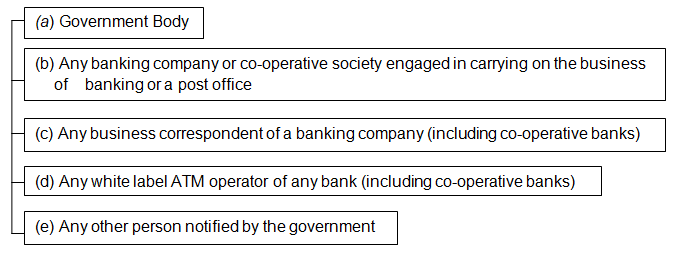
Tax shall not be required to be deducted if cash withdrawal from bank or post office is made by the following recipients:
PRESS RELEASE (30th August, 2019):-

Section 194N inserted in the Act, is to come into effect from 1st September, 2019.Hence, any cash withdrawal prior to 1st September, 2019 will not be subjected to the TDS under section 194N of the Act.
However, since the threshold of Rs. 1 crore is with respect to the previous year, calculation of amount of cash withdrawal for triggering deduction under section 194N of the Act shall be counted from 1st April, 2019.
Some Clarification:-
(i) If amount withdrawn from 1st April to 30th August 2019 is more than 1 crore than any amount withdrawn from 1st Sep 2019, TDS will be applicable.
(ii) Calculation of 1 crore should be bank wise and not branch wise.
Some Example:-
1- Mr. Shubham has withdrawn the following amounts from different branches of two banks 1st is UBI & 2nd is SBI whose amounts are
 UBI (Branch) Amount (in lakhs)
       A         40
       B         30
       C         60
SBI (Branch)  Amount (in lakhs)
      A        20

Particulars               Amount(in Lakhs)
Rs 40 lakh from Branch A

                          40

·    R  Rs 30 lakh from Branch B

                          30
·    R  Rs 50 lakh from Branch C

                          60
·    R  Rs 20 lakh from Branch D of SBI Bank

                           —
·                                                Total                         130
·                TDS (2% on above Rs.1 Crore)(130-100)*2%= 0.60
2- Mr. Suresh has saving with a bank. The details of cash withdrawn from both the accounts are as follows:
    Date     Amount (in lakhs)
15/5/2019                60
09/6/2019                20
01/8/2019                55
05/9/2019                20
In this case Mr. Suresh has withdrawn amount Rs. 135 lakhs before 1st Sep 2019 so any amount withdrawn from 1st Sep TDS at the rate 2% will be applicable. So TDS will be only
on 20 lakhs i.e. (Rs. 20000000*2%) Rs. 40000/-.
In second example if amount withdrawn on 1/8/2019 is Rs. 15 Lakh than TDS will be calculated on Rs. 15 Lakhs (Rs. 20 Lakhs-5 Lakhs) i.e. Rs. 30000/- (Rs. 15 Lakhs*2%).
At Ruchi Anand & Associates, we are all about service. We strive to develop long-term relationships with our clients, approaching each engagement with a focus on bringing value. Our senior professionals are actively involved in each engagement from inception to conclusion with smart sensitive approaches. We are one of top Indian Chartered Accountant Auditing Firms based in India at New Delhi. We provide Audit and Assurance Services, Risk Advisory and Tax Services for improving your financial efficiency, accuracy & stability. For more information visit our website:- http://www.raaas.com.

Thursday, 26 December 2019

GSTR 9, Annual Return Under GST

What is the Annual return?
Consolidation of information furnished in the forms GSTR 1 , GSTR 2 , GSTR 3 & GSTR 3B
Details of Outward Supplies made and Inward Supplies received , categorized into different tax heads:
  • IGST
  • CGST
  • SGST
Types of GSTR 9 Forms
There are 4 types of Annual Returns under GST:
  • GSTR 9 : This is to be filed by regular taxpayers filing GSTR1, GSTR2, GSTR3, GSTR3B
  • GSTR 9A : This is to be filed by taxpayers registered under Composition Scheme
  • GSTR 9B : This is to be filed by e-commerce operators who have filed GSTR 8 during the financial year
  • GSTR 9C : This is to be filed by tax payers required to get their accounts audited under GST
GSTR 9
All the taxable persons/entities registered under GST and filing monthly/quarterly returns, except the following:
  • Casual Taxable persons
  • Input Service Distributors
  • Non-resident taxable persons
  • Persons paying TDS under section 51 of GST Act
Types of GSTR-9 Forms
1. GSTR 9
  • Part I : Basic details of the taxpayer
  • Part II : Details of Outward and Inward supplies declared during the Financial Year
  • Part III : Details of Input Tax Credit (ITC) declared in returns during the Financial Year
  • Part IV : Details of taxes paid under various heads during the Financial Year
  • Part V : Details of amendment or omission entries for returns filed upto the month of September
  • Part VI : Other information comprising details of :
  • GST demands and refunds.
  • HSN wise summary of the quantity of goods supplied and received with its corresponding Tax details.
  • Late fees payable and paid, if any.
  • Bifurcation of inward supplies received from different categories of Taxpayer – Composition dealers , deemed supply and goods on approval basis
1. GSTR 9A
  • To be filed by taxpayers registered under composition scheme filing GSTR 4A during the financial year.
  • The form is divided into 5 parts with 17 tables including basic details , details of outward and inward supplies declared , details of taxes paid.
2. GSTR 9B
To be filed by e-commerce operators filing GSTR 8 during the financial year.
3. GSTR 9C
  • To be filed by taxpayers whose turnover exceeding two crores during the financial year and are required to get their accounts audited by a Chartered Accountant or Cost Accountant
  • The form is divided into 2 parts:
  • Reconciliation Statement
  • Certification
GSTR 9C – Reconciliation Statement
The Reconciliation statement is divided into 5 parts:
  • Part I : Basic Details
  • Part II : Details of Outward and Inward supplies declared during the financial year
  • Part III : Details of ITC as declared in returns filed during the financial year
  • Part IV : Details of tax paid as declared in returns filed during the financial year
  • Part V : Particulars of transactions for the previous FY declared in returns of April to September of current Financial Year
GSTR 9C – Certification
  • The form GSTR 9C can be certified by same Chartered Accountant/Cost Accountant (CA) who conducted the GST Audit or by any other CA who did not conduct the GST Audit.
  • In case the CA certifying the form GSTR 9C did not conduct the GST audit , the CA certifying the form must have based an opinion on the books of accounts audited by the auditor CA.
  • The format of Certification report will thus vary depending on who the certifier of the form is.

Forensic Auditing

Forensic Auditing involves conducting examination and evaluation of a firm’s or individual’s financial information and legalities for determining whether any fraud or negligence has taken place and if yes, to use the evidence collected during such Audit in the court of law.
Objective
The objective of FORENSIC AUDIT is to find the audit evidences which are legally tenable and in doing so the Corporate veil of the company can be disregarded.
Following points are considered
  • Any Fraud or negligence took place?
  • Is the effect material?
  • Who are the responsible people?
  • How much can be recovered?
Skills Required
Following skills are required for an efficient and fruitful Forensic Audit
  • Deep Knowledge of Accounting
  • Proper Understanding of Auditing
  • Required traits of Investigating
  • Obvious should be distrusted
  • Think differently and Develop an open mind
How it differs from Statutory Audit
BasisStatutory AuditForensic Audit
ObjectiveDetermine
“True
and Fair” presentation of financial statements.
Evaluating correctness of the accounts
& whether any fraud or negligence has
actually taken place.
TechniquesProcedures involved are “Substantive” and “compliance”Analyzing
past performance and
Scrutinizing
selected transactions (having material effect)
PeriodTransactions of a specified Accounting Period are
taken into consideration
No limitation of period.
Accounts of previous years (from starting) can be examined
as well.
Adverse
findings, if any
Negative opinion or qualified opinion expressed, with
or without quantification.
Determining legal aspect of fraud and
finding out the persons responsible for such fraud
Critical Point Auditing
Purpose of critical point auditing is screening out the fraud or false transactions and events from the normal ones.
An analysis and evaluation of financial statements, books and records are conducted to find out :
  • False credit to increase sales and corresponding debit entries.
  • Inadequacies in Internal Control System of the organization.
  • Cross debits and credits and inter account transfers
Propriety Audit
Main purpose of Propriety Audit is to determine the genuinity of the transactions in Government Account.
It means whether entire expenditure sanctioned by the government is actually required and need based and whether all the incomes arising on account of that are fairly and timely credited to the government account.
It aims at determining the Value for money, whether the economy and efficiency has been achieved in the transaction and unwanted, wasteful and unnecessary expenses have been ignored.
If anything objectionable or any fraudulent intension is recognized then people and organizations suspected to be behind that are questioned.
Case Studies
Based on Balance Sheet as on 30th June, 2002,showing erosion in net worth, Vivita Ltd. filed a reference U/S 15(1) of Sick Industrial Companies (Special Provisions) Act, 1985. Secured creditors objected on the grounds, amongst others, that:
(a) Requisite number of directors did not attend the meeting of Board of Directors of the company held to decide on reference to BIFR.
(b) Company indulged in the following:-
  • Gave a huge discount of Rs.6.48 crore without any explanation/justification.
  • Company devalued its investments by 90% without explaining reasons for such a devaluation.
  • Company had written off R s. 3.97 crore on account of foreign exchange fluctuations
  • Addition to gross block included Rs.26 lakhs as land development expenses, actually not incurred, as per inspection carried out by banks.
  • Depreciation increased by Rs.1.84 crore despite a fall in fixed assets
BIFR observed that the group companies (to which Vivita belonged) referred to BIFR, though engaged in different activities, adopted the pattern of reporting huge losses on slight fall in sales. Marginal fall in the sales and huge losses accompanied with large discounts in a single financial year was common to all the companies.
Vivita’s Explanation/representation and decision of BIFR
  • Vivita stated huge discounts were offered to liquidate stock, as it feared trademark infringement proceedings by another company. BIFR did not accept this as sufficient evidence was not made available and hence heavy increase in discounts and losses were not allowed
  • Devaluation of investments not admitted as Vivita Ltd failed to submit copy of B.O.D. resolution to ascertain whether it was long-term or short-term investment
  • Explanation of Vivita Ltd as for increase in depreciation was acceptable
  • Considering the market practice in the industry of taking advance from buyers and passing the same to the suppliers, BIFR noted that selling prices and the procurement prices are fixed in advance. BIFR set aside Vivita Ltd’s contention of losses in trading activities and ruled that losses of the company were overstated by Rs. 34.61 crore on account of increase in raw material consumption.
  • As to increase in loans, details were not available, but in case of unsecured loans, BIFR observed that Vivita Ltd. had given preferential treatment in the payment of unsecured loans at the cost of secured loans.
  • Regarding loss of Rs.40 crore on a marginal fall in the sales, Vivita has not submitted any explanation
If you have any query regarding this Click Here