Monday, 6 January 2020

Section 194N – TDS on cash withdrawal in excess of Rs 1 crore

Brief Introduction:-
  • FM Nirmala Sitharaman has presented her first Union Budget on 5 July 2019.
  • The above section shall come into effect from 1st September, 2019.
  • With a view to encourage digital payments and discourage the practice of making payments in cash, the Union Budget 2019 has introduced Section 194N for deduction of tax at source (TDS) on cash withdrawals exceeding Rs 1 crore.
  • TDS deduction on cash withdrawal u/s 194N is applicable to all taxpayers other than some person.
What is Section 194N?
Every person, being-
(i)  a banking company to which the Banking Regulation Act, 1949 (10 of 1949) applies    (including any bank or banking institution referred to in section 51 of that Act);
(ii)  a co-operative society engaged in carrying on the business of banking; or
(iii) a post office
who is responsible for paying any sum, or, as the case may be, aggregate of sums, in cash, in excess of one crore rupees during the previous year, to any person (herein referred to as the recipient) from one or more accounts maintained by the recipient with it shall, at the time of payment of such sum, deducts an amount equal to two per cent of sum exceeding one crore rupees, as per income-tax.
The section will apply to withdrawals made by taxpayer including:-
(a) Individual                                                                         (d) Partnership firm or an LLP
(b) Local authority                                                                (e) Hindu Undivided Family (HUF)
(c) Association of Person or Body of Individuals            (f) Company
Who is required to deduct TDS?
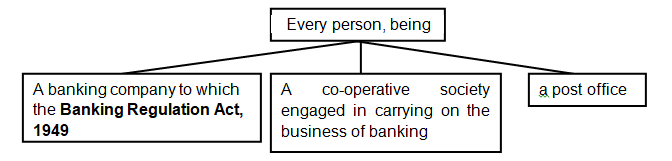
responsible for paying any sum or aggregate of sums in cash in excess of Rs. 1 crore during the previous year, to any person, deduct an amount equal to 2% of sum exceeding Rs. 1 crore.
When tax shall be required to be deducted?
TDS under Section 194N tax shall be required to be deducted only when the aggregate amount of cash withdrawal during the previous year by a person from one or more of his bank or post office account, as the case may be, exceeds Rs. 1 crore.
Rate of TDS:-
The payer will have to deduct TDS at the rate of 2% on the cash payments/withdrawals of more than Rs 1 crore in a financial year under Section 194N.
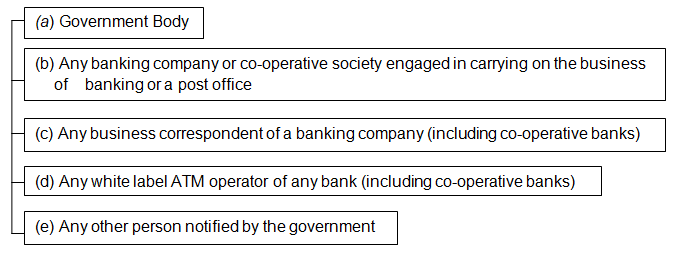
When tax shall not be required to be deducted?
Tax shall not be required to be deducted if cash withdrawal from bank or post office is made by the following recipients:
PRESS RELEASE (30th August, 2019):-
Section 194N inserted in the Act, is to come into effect from 1st September, 2019.Hence, any cash withdrawal prior to 1st September, 2019 will not be subjected to the TDS under section 194N of the Act.
However, since the threshold of Rs. 1 crore is with respect to the previous year, calculation of amount of cash withdrawal for triggering deduction under section 194N of the Act shall be counted from 1st April, 2019.
Some Clarification:-
(i) If amount withdrawn from 1st April to 30th August 2019 is more than 1 crore than any amount withdrawn from 1st Sep 2019, TDS will be applicable.
(ii) Calculation of 1 crore should be bank wise and not branch wise.
Some Example:-
1- Mr. Shubham has withdrawn the following amounts from different branches of two banks 1st is UBI & 2nd is SBI whose amounts are
 UBI (Branch) Amount (in lakhs)
       A         40
       B         30
       C         60
SBI (Branch)  Amount (in lakhs)
      A        20

Particulars               Amount(in Lakhs)
Rs 40 lakh from Branch A

                          40

·    R  Rs 30 lakh from Branch B

                          30
·    R  Rs 50 lakh from Branch C

                          60
·    R  Rs 20 lakh from Branch D of SBI Bank

                           —
·                                                Total                         130
·                TDS (2% on above Rs.1 Crore)(130-100)*2%= 0.60
2- Mr. Suresh has saving with a bank. The details of cash withdrawn from both the accounts are as follows:
    Date     Amount (in lakhs)
15/5/2019                60
09/6/2019                20
01/8/2019                55
05/9/2019                20
In this case Mr. Suresh has withdrawn amount Rs. 135 lakhs before 1st Sep 2019 so any amount withdrawn from 1st Sep TDS at the rate 2% will be applicable. So TDS will be only
on 20 lakhs i.e. (Rs. 20000000*2%) Rs. 40000/-.
In second example if amount withdrawn on 1/8/2019 is Rs. 15 Lakh than TDS will be calculated on Rs. 15 Lakhs (Rs. 20 Lakhs-5 Lakhs) i.e. Rs. 30000/- (Rs. 15 Lakhs*2%).
At Ruchi Anand & Associates, we are all about service. We strive to develop long-term relationships with our clients, approaching each engagement with a focus on bringing value. Our senior professionals are actively involved in each engagement from inception to conclusion with smart sensitive approaches. We are one of top Indian Chartered Accountant Auditing Firms based in India at New Delhi. We provide Audit and Assurance Services, Risk Advisory and Tax Services for improving your financial efficiency, accuracy & stability. For more information visit our website:- http://www.raaas.com.

Thursday, 26 December 2019

GSTR 9, Annual Return Under GST

What is the Annual return?
Consolidation of information furnished in the forms GSTR 1 , GSTR 2 , GSTR 3 & GSTR 3B
Details of Outward Supplies made and Inward Supplies received , categorized into different tax heads:
  • IGST
  • CGST
  • SGST
Types of GSTR 9 Forms
There are 4 types of Annual Returns under GST:
  • GSTR 9 : This is to be filed by regular taxpayers filing GSTR1, GSTR2, GSTR3, GSTR3B
  • GSTR 9A : This is to be filed by taxpayers registered under Composition Scheme
  • GSTR 9B : This is to be filed by e-commerce operators who have filed GSTR 8 during the financial year
  • GSTR 9C : This is to be filed by tax payers required to get their accounts audited under GST
GSTR 9
All the taxable persons/entities registered under GST and filing monthly/quarterly returns, except the following:
  • Casual Taxable persons
  • Input Service Distributors
  • Non-resident taxable persons
  • Persons paying TDS under section 51 of GST Act
Types of GSTR-9 Forms
1. GSTR 9
  • Part I : Basic details of the taxpayer
  • Part II : Details of Outward and Inward supplies declared during the Financial Year
  • Part III : Details of Input Tax Credit (ITC) declared in returns during the Financial Year
  • Part IV : Details of taxes paid under various heads during the Financial Year
  • Part V : Details of amendment or omission entries for returns filed upto the month of September
  • Part VI : Other information comprising details of :
  • GST demands and refunds.
  • HSN wise summary of the quantity of goods supplied and received with its corresponding Tax details.
  • Late fees payable and paid, if any.
  • Bifurcation of inward supplies received from different categories of Taxpayer – Composition dealers , deemed supply and goods on approval basis
1. GSTR 9A
  • To be filed by taxpayers registered under composition scheme filing GSTR 4A during the financial year.
  • The form is divided into 5 parts with 17 tables including basic details , details of outward and inward supplies declared , details of taxes paid.
2. GSTR 9B
To be filed by e-commerce operators filing GSTR 8 during the financial year.
3. GSTR 9C
  • To be filed by taxpayers whose turnover exceeding two crores during the financial year and are required to get their accounts audited by a Chartered Accountant or Cost Accountant
  • The form is divided into 2 parts:
  • Reconciliation Statement
  • Certification
GSTR 9C – Reconciliation Statement
The Reconciliation statement is divided into 5 parts:
  • Part I : Basic Details
  • Part II : Details of Outward and Inward supplies declared during the financial year
  • Part III : Details of ITC as declared in returns filed during the financial year
  • Part IV : Details of tax paid as declared in returns filed during the financial year
  • Part V : Particulars of transactions for the previous FY declared in returns of April to September of current Financial Year
GSTR 9C – Certification
  • The form GSTR 9C can be certified by same Chartered Accountant/Cost Accountant (CA) who conducted the GST Audit or by any other CA who did not conduct the GST Audit.
  • In case the CA certifying the form GSTR 9C did not conduct the GST audit , the CA certifying the form must have based an opinion on the books of accounts audited by the auditor CA.
  • The format of Certification report will thus vary depending on who the certifier of the form is.

Forensic Auditing

Forensic Auditing involves conducting examination and evaluation of a firm’s or individual’s financial information and legalities for determining whether any fraud or negligence has taken place and if yes, to use the evidence collected during such Audit in the court of law.
Objective
The objective of FORENSIC AUDIT is to find the audit evidences which are legally tenable and in doing so the Corporate veil of the company can be disregarded.
Following points are considered
  • Any Fraud or negligence took place?
  • Is the effect material?
  • Who are the responsible people?
  • How much can be recovered?
Skills Required
Following skills are required for an efficient and fruitful Forensic Audit
  • Deep Knowledge of Accounting
  • Proper Understanding of Auditing
  • Required traits of Investigating
  • Obvious should be distrusted
  • Think differently and Develop an open mind
How it differs from Statutory Audit
BasisStatutory AuditForensic Audit
ObjectiveDetermine
“True
and Fair” presentation of financial statements.
Evaluating correctness of the accounts
& whether any fraud or negligence has
actually taken place.
TechniquesProcedures involved are “Substantive” and “compliance”Analyzing
past performance and
Scrutinizing
selected transactions (having material effect)
PeriodTransactions of a specified Accounting Period are
taken into consideration
No limitation of period.
Accounts of previous years (from starting) can be examined
as well.
Adverse
findings, if any
Negative opinion or qualified opinion expressed, with
or without quantification.
Determining legal aspect of fraud and
finding out the persons responsible for such fraud
Critical Point Auditing
Purpose of critical point auditing is screening out the fraud or false transactions and events from the normal ones.
An analysis and evaluation of financial statements, books and records are conducted to find out :
  • False credit to increase sales and corresponding debit entries.
  • Inadequacies in Internal Control System of the organization.
  • Cross debits and credits and inter account transfers
Propriety Audit
Main purpose of Propriety Audit is to determine the genuinity of the transactions in Government Account.
It means whether entire expenditure sanctioned by the government is actually required and need based and whether all the incomes arising on account of that are fairly and timely credited to the government account.
It aims at determining the Value for money, whether the economy and efficiency has been achieved in the transaction and unwanted, wasteful and unnecessary expenses have been ignored.
If anything objectionable or any fraudulent intension is recognized then people and organizations suspected to be behind that are questioned.
Case Studies
Based on Balance Sheet as on 30th June, 2002,showing erosion in net worth, Vivita Ltd. filed a reference U/S 15(1) of Sick Industrial Companies (Special Provisions) Act, 1985. Secured creditors objected on the grounds, amongst others, that:
(a) Requisite number of directors did not attend the meeting of Board of Directors of the company held to decide on reference to BIFR.
(b) Company indulged in the following:-
  • Gave a huge discount of Rs.6.48 crore without any explanation/justification.
  • Company devalued its investments by 90% without explaining reasons for such a devaluation.
  • Company had written off R s. 3.97 crore on account of foreign exchange fluctuations
  • Addition to gross block included Rs.26 lakhs as land development expenses, actually not incurred, as per inspection carried out by banks.
  • Depreciation increased by Rs.1.84 crore despite a fall in fixed assets
BIFR observed that the group companies (to which Vivita belonged) referred to BIFR, though engaged in different activities, adopted the pattern of reporting huge losses on slight fall in sales. Marginal fall in the sales and huge losses accompanied with large discounts in a single financial year was common to all the companies.
Vivita’s Explanation/representation and decision of BIFR
  • Vivita stated huge discounts were offered to liquidate stock, as it feared trademark infringement proceedings by another company. BIFR did not accept this as sufficient evidence was not made available and hence heavy increase in discounts and losses were not allowed
  • Devaluation of investments not admitted as Vivita Ltd failed to submit copy of B.O.D. resolution to ascertain whether it was long-term or short-term investment
  • Explanation of Vivita Ltd as for increase in depreciation was acceptable
  • Considering the market practice in the industry of taking advance from buyers and passing the same to the suppliers, BIFR noted that selling prices and the procurement prices are fixed in advance. BIFR set aside Vivita Ltd’s contention of losses in trading activities and ruled that losses of the company were overstated by Rs. 34.61 crore on account of increase in raw material consumption.
  • As to increase in loans, details were not available, but in case of unsecured loans, BIFR observed that Vivita Ltd. had given preferential treatment in the payment of unsecured loans at the cost of secured loans.
  • Regarding loss of Rs.40 crore on a marginal fall in the sales, Vivita has not submitted any explanation
If you have any query regarding this Click Here

Thursday, 28 November 2019

GST UPDATES


1. GST Press Release Dated 14th November,2019 : Due dates of filing of Form GSTR-9 (Annual Return) and Form GSTR-9C (Reconciliation Statement) for Financial Year 2017-18 extended to 31 st December 2019.
2.Due dates of filing of kind GSTR-9 (Annual Return) and kind GSTR-9C (Reconciliation Statement) for year 2018-19 to extended thirty one st March 2020.
3. No ought to fill HSN level info of outward and inward provides.And to not offer bifurcation of input step-down availed on inputs, input services and capital product.
4. GST changes created area unit as below: kind GSTR 9: Table – four (Outward Supply): 4B To 4E are often stuffed internet of Credit Notes, Debit Notes and Amendments*, rather than reportage in severally in 4I, 4J 4K & 4L;
5. GST Changes: Table 5A to 5F are often stuffed internet of Credit Notes, Debit Notes and Amendments, rather than reportage in severally in 5H, 5I, 5J & 5KJ; just in case of Table 5D, 5E & 5F ( exempted, cypher rated and Non-GST supply) – *Single figure are often rumored against EXEMPTED* in 5D;
6. GST Changes: Table vi – ITC availed throughout the FY,  In Table 6B, 6C, 6D & 6E the registered person will report the complete input step-down underneath the *“inputs” row only*;  Table seven – ITC Reversal: Details of table 7A to 7E are often rumored underneath 7H (Other Reversal); but TRAN I & II reversal has got to be rumored respectively;
7. GST Changes: Table eight – alternative ITC connected information: The registered person will transfer the small print for the entries in Table 8A to 8D (Reconciliation of GSTR 2A with GSTR 3B) *duly signed, in PDF format in kind GSTR-9C* (without the CA certification); Table fifteen, 16, seventeen (*HSN outline also*) has been created nonobligatory
8. kind GSTR 9C: Some relaxation has been created during this kind conjointly that area unit as below: Detail of turnover changes needed in *Table 5B to 5N created optional* and every one the adjustment needed to be rumored are often rumored in Table 5O;
9. GST Changes: Table 12B, 12C and fourteen (ITC reconciliation) has conjointly been created optional; Some minor changes in Declaration half conjointly.
10. No GST returns, no E-way bills! Centre to throttle on non-filers: involved with the dipping monthly collections of products and Services Tax (GST), the govt. and revenue enhancement department area unit currently coming up with stricter measures against non-compliant taxpayers.
11. GST department is currently reaching to block the power to get e-way bill for taxpayers World Health Organization don’t file 2 consecutive GSTR-3B returns wef 17 November 2019. Once the remunerator has filed one in every of the unfinished returns, the power to get e-way bill are mechanically improved.

Friday, 8 November 2019

How can one convert a Partnership firm to a Private Limited Company?

feedback.jpg

India is known for many start-ups.  We must have noticed that every day some of the other startups get established in our country. Due to globalization, the startup culture is showing a positive trend in recent times. This startup culture is mainly undertaken by those entrepreneurs who are ambitious and want to achieve something in their life.

With sheer determination and hearth in their belly, several young aspiring entrepreneurs area unit going ahead with beginning their own company be it a ownership firm or a Partnership registration.
A Partnership is one in every of the foremost well-known sorts of business constitution. it’s owned , managed associated controlled by an association of 2 or a lot of persons entirely for the aim of creating a profit. These sorts of business considerations area unit standard among little and medium based mostly business organizations that have restricted capital. they’re comparatively straightforward to make since they need solely minimum formalities.

Now suppose if your partnership is basically doing well can you continue with identical business entity or would you wish to require an extra jump?
Obviously for no reasons one would undoubtedly favor to take one step ahead. Imagine what is going to be your goals and wherever would you stand five years down the line?

If you discover that your business is flourishing and there area unit investors to back-up and grant funding can you continue to follow identical business entity? undoubtedly, you’ll be trying to find growth so the planet are observing you from a special perspective. Don’t they?

This is once one will check up on changing from a partnership firm to a personal Ltd.. thanks to corporatization happening in an exceedingly brisk manner the complete world is step by step inching towards single world market while not making any obstacles in trade among the countries. Expand your business reach with higher funding, credibleness, and security by changing to a personal Ltd..

The major advantage of personal Ltd. registration is that it provides a standing of a separate legal entity that a partnership firm doesn’t supply. just in case of a partnership, a partner’s personal assets area unit hooked up and that they would be control in person chargeable for every and each debt or liability arising out of the business. Therefore, with the growth of business, if the partners wish to extend their credibleness and place liability on its members, it’s a lot of sensible to convert their partnership into a personal Ltd.. albeit the legal compliances for a personal Ltd. area unit a lot of beyond those of a partnership concern, it provides the firm a lot of opportunities to expand and flourish the business.

Thursday, 22 August 2019

Register your Trademark


In today’s competitive world, once protective the identity of a business is extremely robust, it’s terribly crucial to shield distinctive identity of your business and your rights. to tell apart a business from others, Trademark, Patents and Copyrights ar used. However, employing a trademark doesn’t offer you exclusive rights over it unless you register the trademark below the Trade Marks Act, 1999. Trademark may be a de jure perceptible mark, like word, logo, device, symbol, or label. anyone (natural or artificial) will apply for a Trademark registration, together with a Body company, Company, Association of individuals, Individual, Startups, little Enterprises, proprietary Concern and lots of additional. it’s a particular character which supplies its owner exclusive rights of usage and additionally safeguards the mark from others.
You can apply for trademark registration below each on-line and off-line modes. There ar forty five classes below that a trademark is registered. These classes represent the kind of business that a trademark are registered. For the whole registration of your trademark, the Trademark department provides United States of America with the subsequent varied statuses:
  • Formality Check Process: Once AN application for trademark registration is filed, all the documents hooked up to that ar 1st cross examined.
  • Marked for Exam: once the formalities ar passed, the applying is marked for examination wherever the registrar checks on the similarities and different discrepancies arising among some relevant/alike registered marks.
  • Objection: once scrutinizing the trade mark application, objections could also be raised by the Registrar/Examiner below Sections nine and eleven of the Trade Marks Act, specializing in the descriptive goods/generic/laudatory/indicating quality or nature of products and identical/similar trade mark in respect of identical/similar goods/services already on record within the Trade Mark written record.
    Advertised before Acceptance: once the mark is however not accepted by the department however isn’t having any objection in advertising it within the journal.
  • Accepted & Advertised: this can be shown once the mark is each accepted by the department and publicized  within the journal.
    Abandoned: once the reply for the examination report or any objection report isn’t stuffed inside the time given, then the applying shall be termed as Abandoned.
  • Opposition: If anyone is already mistreatment the similar Trademark, he could file AN opposition letter. Registrar shall issue notice of hearing and each the parties shall gift their case.
  • Registered: once all the objections and needs ar consummated, then the mark is registered.
  • Withdrawal: once the soul wilfully withdraws the applying stuffed.
In best situation, a trademark gets registered in 8-12 months. the amount could get extended supported the criticalities concerned and objections raised against the trademark.

If you have any Query, Click here

Tuesday, 6 August 2019

What is GSTR-9?


Hello, during this post we’ll discuss all relating to GSTR-9 or the GST annual come back. Meaning, differing kinds, maturity and GSTR nine format or the main points. Also, we’ve got given a downloadable PDF of GSTR- nine format. scan the complete post to understand additional.
Meaning of GSTR nine
GSTR nine is that the annual come back. it’s a compilation come back which has all business transactions in dire straits the actual twelvemonth. GSTR-9 consists of details regarding the provides created and received throughout the year below totally different tax heads i.e., CGST, SGST, and IGST. It consolidates the data equipped within the monthly/quarterly returns throughout the actual year.
GSTR-9 maturity
The maturity to file the GSTR-9 is thirty first Dec of the preceding year. as an example, thirty first December 2018 for the FY 2017-18.
Frequently Asked queries on GSTR-9
1. that type to be filed PAN or GSTN wise?
GSTN wise i.e., on an individual basis for every GSTN.
2. What if your GSTN is Cancelled?
Even if your GSTN is off, say throughout FY 2017-18, taxpayers area unit needed to file GSTR-9.
3. WHO cannot file GSTR-9?
Below is that the list of WHO cannot file GSTR-9:
  • Composition Dealers
  • Input Service Distributors
  • Tax Deductor
  • Tax Collector
  • Casual ratable person
  • Non-resident ratable person
4. that type Composition Dealer must file?
Composition dealer must file GSTR-9A.
5. What if opted out or in Composition Dealer throughout the year?
If you have got opted out or in Composition Dealer throughout the year, the payer must file GSTR-9 and GSTR- 9A for the relevant periods.
6. Is it necessary to file goose egg Return?
Yes, it’s necessary to file goose egg come back.
7. what’s a 0 return?
Nil come back are often filed for the twelvemonth if you have got not: –
  • made any outward offer (commonly called a sale)
  • Received any product / services (also usually called a purchase)
  • Have no alternative liability to report
  • Claimed any person any refund
  • Received any order making demand
8. that type to file if you have got the turnover higher than Rs. 2 crores?
You need to file GSTR-9C once filing GSTR-9.
9. will GSTR-9 be filed if the payer has not filed GSTR-1 and GSTR-3B?
GSTR-9 can’t be filed unless GSTR-3B and GSTR-1 area unit filed.
10. will GSTR-9 be revised?
No, presently GSTR-9 doesn’t enable any revision once filing.
11. Implication of cant in GSTR nine filed?
Incorrect information will attract tax demands, interest and penalties on identical and also the long-run litigations that follow years later.
12. will extra liability be paid?
Liability known throughout the filing of annual come back are often deposited with Government exploitation DRC-03 type (i.e., Liability not earlier paid through GSTR-3B)
13. can the extra liability be auto-calculated within the Form?
No, liabilities must be self-calculated and additionally self-deposited (Except Late filing fees of GSTR-9)
14. will extra ITC be claimed?
ITC that isn’t claimed in GSTR-3B can’t be claimed in GSTR-9. Also, identical must be claimed in GSTR-3B upto the extended timeline for claiming input credit.